Psyllium Husk: Benefits, Dosage, and Why Most
Supplements Miss the Mark
By Cris Canto | Chemist (MSc) | The Label Truth — Last Updated: July 2026
If you have spent any time looking at gut health supplements, you have seen psyllium husk listed as an ingredient. It shows up in fiber blends, digestive support formulas, and weight management products across every price range and brand. It is one of the most studied dietary fibers in existence — and unlike many supplement ingredients, the research behind it is genuinely solid.
But here is the problem: psyllium husk has an FDA-authorized health claim for cardiovascular disease — one of the highest regulatory bars any supplement ingredient can clear. Most products on the market deliver 2–5 g per serving when the clinical evidence required 10–12 g for cholesterol reduction. Knowing the science exists is not the same as knowing whether the product in front of you actually delivers it.
In this article I cover what psyllium husk is chemically, what the published research shows benefit by benefit, the psyllium husk dose ranges that matter, the side effects you need to know, and what I check on every supplement label when I see this ingredient. If you want the full label-reading guide, see my chemist’s guide to supplement facts panels.
| Quick summary ✅ Digestive regularity: strong, consistent evidence (5–10 g/day) ✅ Cholesterol: FDA-authorized health claim — 10–12 g/day required (PMID 10648260) ✅ Blood sugar: significant reduction in HbA1c and fasting glucose (PMID 38844885) ⚠️ Most gut supplements deliver 1–3 g — well below therapeutic doses |
What Psyllium Husk Actually Is — and Why Label Wording Matters
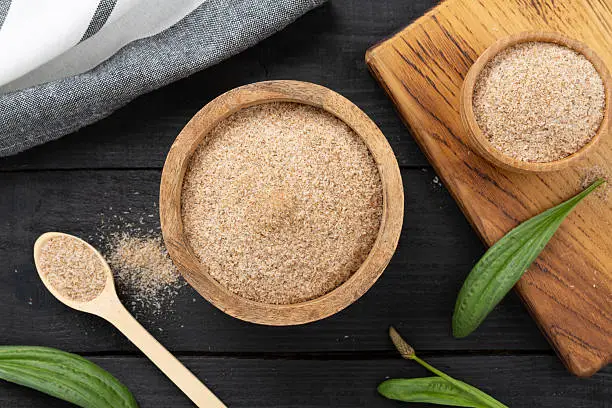
Psyllium husk comes from the seed coat of Plantago ovata, a plant cultivated primarily in India. The husk — the outer shell of the seed — is where the fiber is concentrated. Chemically, psyllium husk is composed primarily of arabinoxylan, a polysaccharide with an unusual property: it is highly soluble in water and forms a viscous gel when hydrated. This gel-forming behavior is responsible for all of psyllium husk’s documented physiological effects.
Label wording matters here. When you see “psyllium husk” on a supplement facts panel, you are looking at the seed coat. When you see “psyllium seed” or “psyllium seed powder,” you are looking at the whole seed — which contains significantly less soluble fiber than the isolated husk. These are not the same thing. All clinical research was conducted with the husk, not the whole seed. A product listing psyllium seed and claiming the same benefits is not supported by the evidence.
What the Research Shows — Benefit by Benefit
Digestive Regularity — Strongest Evidence
This is where psyllium husk has the strongest and most consistent evidence base. The mechanism is straightforward: the gel absorbs water in the intestine, increases stool bulk, softens stool consistency, and makes transit easier in both directions — reducing both constipation and loose stools. This bidirectional effect is unusual for a fiber supplement and makes psyllium husk one of the most versatile options for IBS, where symptoms can alternate between constipation and diarrhea.
The FDA has recognized psyllium husk as an approved ingredient for over-the-counter use for irregularity. This level of regulatory recognition is rare for a supplement ingredient.
Effective psyllium husk dose: 5–10 g/day in 2–3 divided doses with meals and at least 240 ml of water per dose.
Cholesterol Reduction — FDA-Authorized Health Claim
Psyllium husk is one of only a handful of dietary ingredients with an FDA-authorized health claim for cardiovascular disease (Final Rule, 1998). The mechanism: the viscous gel binds bile acids in the small intestine. Bile acids are synthesized from cholesterol. When they are excreted rather than reabsorbed, the liver draws on circulating cholesterol to produce more — effectively lowering LDL.
A meta-analysis of 8 controlled trials (PMID 10648260) found that 10.2 g/day lowered total cholesterol by 4% and LDL by 7% in hypercholesterolemic adults. Effects were dose-dependent and more pronounced in people with higher baseline LDL. Products providing 2–3 g per serving and claiming cardiovascular benefit are not aligned with this evidence.
Effective psyllium husk dose: 10–12 g/day. Products below 5 g per serving cannot reasonably claim meaningful cholesterol benefit.
Blood Sugar and Insulin Response
A 2024 systematic review and meta-analysis of 19 RCTs (PMID 38844885) found that psyllium husk significantly reduced fasting blood glucose, HbA1c, and HOMA-IR in people with type 2 diabetes or prediabetes. The mechanism is the same gel property: slowing gastric emptying and reducing the rate of glucose absorption in the small intestine, blunting the post-meal blood sugar spike.
This is one of the most clinically relevant effects for evaluating gut health supplements that claim blood sugar support. If a product contains psyllium husk below 5 g per serving, it cannot reasonably deliver meaningful glycemic effects based on this literature.
Effective psyllium husk dose: 5–15 g/day before meals to maximize the glucose-blunting effect.
Weight Management — Real but Modest
The evidence is real but more modest than the marketing often suggests. Psyllium husk supports weight management primarily through two mechanisms: increased satiety by slowing gastric emptying, and a small reduction in post-meal caloric absorption from the gel limiting enzyme-food interaction.
A 2020 review found modest but statistically significant reductions in body weight and BMI — primarily in overweight individuals with metabolic syndrome. The effect size is small compared to caloric restriction. Psyllium husk belongs in a gut health formula as a primary fiber, not as a weight loss hero ingredient.
Effective psyllium husk dose: 5–10 g taken 30 minutes before meals with at least 250 ml of water.
Psyllium Husk Dose: What Research Used vs. What Products Deliver
This table is what most supplement reviews leave out. The clinical evidence is solid — but it was generated at psyllium husk dose levels most commercial products do not deliver.
| Benefit | Research Dose | Typical Product Dose | Gap |
| Cholesterol reduction | 10–12 g/day | 2–3 g/serving | ❌ 3–5× underdosed |
| Blood sugar management | 5–15 g/day | 1–3 g/serving | ❌ Often underdosed |
| Digestive regularity | 5–10 g/day | 2–5 g/serving | ⚠️ Borderline |
| Satiety/weight | 5–10 g/day (before meals) | 1–3 g/serving | ❌ Often underdosed |
Critical note: psyllium husk must always be taken with water. The gel-forming property that produces all the benefits above requires hydration. Taking the powder without adequate water can cause it to swell in the esophagus — uncomfortable and potentially dangerous. Most research uses at least 240–300 ml per dose. Products that omit this instruction are worth noting.
Side Effects and Safety
Psyllium husk has a well-established safety profile. Studies have used up to 30 g/day without safety concerns in healthy adults. That said, there are side effects worth knowing before starting.
- Bloating and gas: The most common side effect, especially in weeks 1–2. The gut microbiome adapts to increased fiber intake. Start at 3–5 g/day and increase gradually over 2–3 weeks.
- Medication interactions — most important: Psyllium husk slows gastric emptying and absorption. It can reduce absorption rate of thyroid medications (levothyroxine), metformin, and some blood pressure medications. Standard recommendation: take psyllium husk 2 hours before or after any medications.
- Allergic reactions: Rare but documented — higher in people with occupational psyllium dust exposure. If you have a known allergy to psyllium or Plantago species, avoid it.
- Choking hazard: Never take psyllium husk powder dry. Always with at least 240 ml of water.
What I Look for on a Supplement Label
When I evaluate a gut health supplement and see psyllium husk, I check four things:
- 1. Is it psyllium husk specifically? Not psyllium seed, not “fiber blend.” The husk is where the research-backed soluble fiber is concentrated.
- 2. Is the dose disclosed and meaningful? If the product uses a proprietary blend, I calculate whether the total blend weight could accommodate a therapeutic dose. For digestive regularity, that means at least 5 g. A 2 g blend across six ingredients cannot deliver a useful psyllium dose.
- 3. Where does it appear in the ingredient list? In a formula making regularity claims, psyllium husk should be one of the first ingredients by weight. If it appears fifth or sixth, the dose is likely sub-therapeutic.
- 4. What is it combined with? Psyllium husk works synergistically with probiotics — particularly Lactobacillus acidophilus — because the soluble fiber acts as prebiotic support for the probiotic strains. Formulas combining psyllium husk with clinically characterized probiotic strains are more scientifically coherent than those combining it with random botanicals.
Psyllium Husk in Gut Health Formulas — What I Found
I have analyzed several gut health supplements that use psyllium husk as a core ingredient. Two stand out for having it at meaningful amounts alongside other well-researched ingredients.
SynoGut lists psyllium husk as its first ingredient by weight, meaning it is present in the largest amount in the formula. Combined with L. acidophilus, bentonite clay, apple pectin, and oat bran, it creates a synbiotic-style formula where the fiber serves as prebiotic support.
GutOptim takes a similar approach — psyllium husk leads the formula alongside apple pectin, konjac glucomannan, and L. acidophilus. The inclusion of bentonite clay adds an adsorption component that makes the formula more comprehensive than simple fiber-plus-probiotic.
A dedicated SynoGut vs GutOptim comparison article is coming soon.
Affiliate disclosure: The GutOptim link above is an affiliate link. I receive a commission if you purchase through them, at no additional cost to you. My formula analyses are conducted independently.
The Bottom Line
Psyllium husk is one of the most evidence-backed fiber supplements available. The digestive regularity evidence is strong and consistent, especially when the psyllium husk dose is at or above 5 g/day. The cardiovascular evidence earned an FDA-authorized health claim. The blood sugar effects are meaningful for people with metabolic concerns.
The psyllium husk dose matters enormously. Products providing less than 5 g per serving cannot deliver the benefits documented in most research. Proprietary blends that obscure whether a therapeutic dose is present deserve extra scrutiny.
For most people, psyllium husk powder taken directly — 5–10 g/day in divided doses with plenty of water — is the most cost-effective and dose-controllable option. Supplement formulas that combine it with compatible probiotic strains add value only if the psyllium is present at a meaningful psyllium husk dose and the probiotic strains are clinically characterized.clinically characterized.
Frequently asked questions
How much psyllium husk should I take per day?
The right psyllium husk dose depends on your goal. For digestive regularity: 5–10 g/day in divided doses with meals. For cholesterol reduction: 10–12 g/day. For blood sugar management: 5–15 g/day before meals. Always start at the lower end and increase gradually over 2–3 weeks to minimize bloating.
Can I take psyllium husk every day?
Yes — daily use is safe for most adults and is how it was used in most long-term research. Key caveats: take with at least 240 ml water per dose, take 2 hours away from medications to avoid absorption interference, and allow 2–3 weeks for your gut to adjust if you are new to fiber supplementation.
What is the difference between psyllium husk and psyllium seed powder?
BPsyllium husk is the seed coat of Plantago ovata — the fiber-dense outer layer. Psyllium seed powder includes the whole seed and contains significantly less soluble fiber per gram. All clinical research was conducted with the isolated husk. Check the label to confirm you are getting psyllium husk specifically.
Is psyllium husk the same as Metamucil?
Metamucil is the most well-known brand of psyllium husk supplement. The active ingredient is the same. Branded and generic psyllium husk products using the same dose and form should produce equivalent effects. Differences lie in excipients, flavoring, and format — not in the active fiber.
Does psyllium husk work for IBS
Psyllium husk has moderate evidence for IBS, particularly the constipation-predominant subtype. Its bidirectional effect on stool consistency — reducing both constipation and diarrhea — makes it one of the more versatile fiber supplements for IBS, where symptoms can alternate.
Why do most gut health supplements underdose psyllium husk?
Because psyllium husk at clinically effective doses takes up a lot of capsule space. A standard capsule holds about 500 mg. Delivering 5 g requires 10 capsules. Most supplements compromise on the psyllium husk dose to keep serving size manageable — which means the psyllium husk in them functions more as a label decoration than as an active ingredient.
Can psyllium husk lower blood pressure?
Some studies suggest modest blood pressure reductions when the psyllium husk dose is consistent and sustained, likely secondary to LDL-lowering and weight effects rather than a direct antihypertensive mechanism. The evidence for blood pressure specifically is less robust than for cholesterol and blood sugar.
References
| PMID | Reference |
| 10648260 | Anderson JW et al. (2000). Cholesterol-lowering effects of psyllium intake adjunctive to diet therapy — meta-analysis of 8 controlled trials. PubMed → |
| 38844885 | Xiao Z et al. (2024). Effect of psyllium on glycemic control — systematic review and meta-analysis of 19 RCTs. PubMed → |
| FDA 1998 | FDA Authorized Health Claim — Psyllium Husk and Coronary Heart Disease (Final Rule, 1998). FDA → |
Analysis by Cris Canto, MSc Chemistry | 25 years of experience in Research & Development and Marketing in multinational consumer goods and chemical industries | All analyses are independent and based on publicly available label data and verified reviews.