
By Cris Canto | Chemist (MSc) | The Label Truth — Last Updated: July 2026
The idea of taking an oral probiotic sounds counterintuitive at first. Most people associate probiotics with gut health — yogurt, digestive supplements, microbiome support. The connection between bacteria and oral health is more familiar in a negative context: the bacteria that cause cavities, gum disease, and bad breath.
But the science behind oral probiotics — also called mouth probiotics or dental probiotics — is more substantive than the marketing suggests. The oral microbiome is a distinct and complex ecosystem, and there is real published evidence that specific bacterial strains introduced directly into the mouth can shift that ecosystem in ways that benefit gum health, reduce bad breath, and compete with the bacteria responsible for dental problems.
The key word is specific. Not all oral probiotics work for the same targets, and the strains that do need to be delivered in the right format. A standard swallowable capsule cannot deliver bacteria to oral tissue. This is the first filter I apply to any oral probiotic supplement — before I even look at which strains it contains. In this article I cover what the published research shows strain by strain, what to check on a supplement facts panel, and what separates a formula that works from one that does not.
If you want to see this framework applied to a specific product comparison, see my ProDentim vs GumAktiv analysis.
| Quick summary ✅ L. reuteri: strong RCT evidence for gum health in lozenge form (PMID 24164569) ✅ BLIS K-12: best evidence for chronic bad breath reduction (PMID 16553730) ✅ Oral-systemic link: oral dysbiosis associated with cardiovascular disease (PMID 35244969) 🚫 A standard swallowable capsule bypasses the oral cavity entirely — fundamental delivery problem |
Why the Oral Microbiome Is Different From the Gut Microbiome
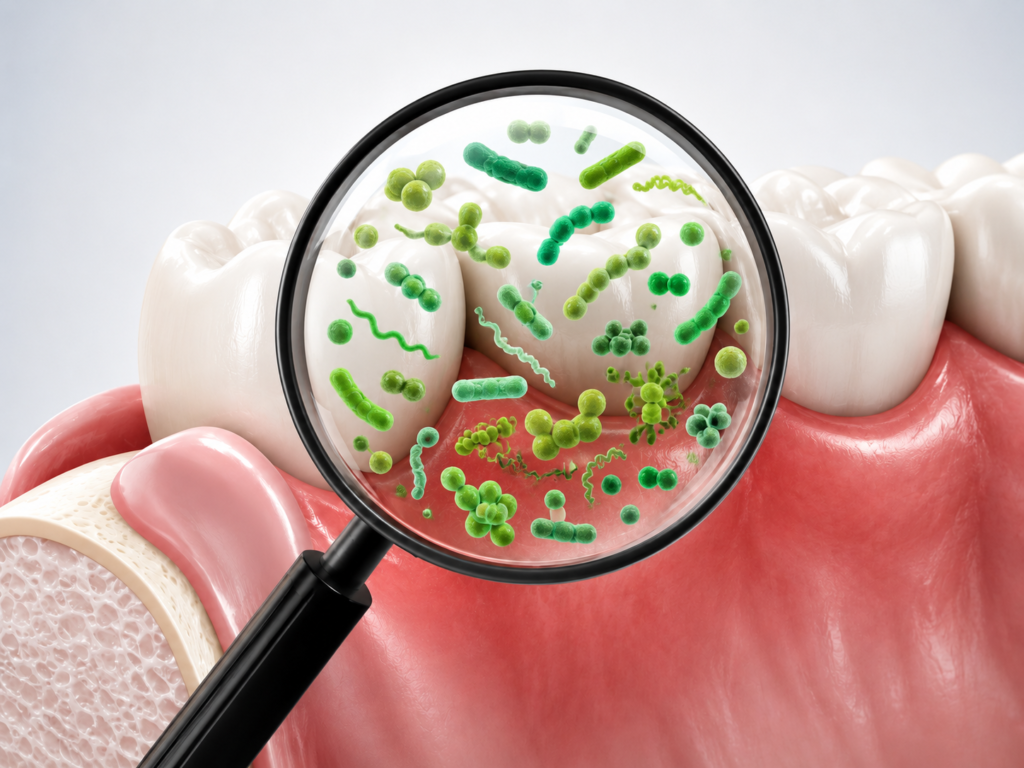
Your mouth hosts approximately 700 species of bacteria — a distinct microbial community separate from the gut microbiome, with its own balance of beneficial and pathogenic species. An oral probiotic designed for gut colonization is not going to colonize your oral tissue. Bacteria need to contact the tissue they are meant to inhabit.
This is why delivery format is the first thing I check. A swallowable capsule delivers bacteria directly to the stomach and small intestine — exactly where you want them for gut health, and exactly not where you need them for oral health. Oral probiotics in dissolvable form — tablets, lozenges, or chewables — spend time in the mouth and allow bacteria to contact oral tissue and begin colonization. A product marketed for oral health in a standard swallowable capsule has a fundamental delivery problem regardless of what strains it contains.
The oral microbiome’s health consequences extend beyond the mouth. A 2022 review (PMID 35244969) found associations between oral dysbiosis and systemic conditions including cardiovascular disease. The mechanism involves both systemic inflammation and bacterial translocation from the mouth into the bloodstream through compromised gum tissue. This is now mainstream in dental and medical research.
The Strains With Real Clinical Evidence
Here is what the literature actually shows for the strains most commonly found in oral probiotic supplements — organized by evidence grade:
| Strain | Primary Benefit | Evidence Grade | Required Format |
| L. reuteri DSM 17938 | Gum health / periodontitis | Strong — multiple RCTs | Lozenge or chewable |
| BLIS K-12 (S. salivarius) | Bad breath (halitosis) | Moderate-strong | Lozenge or chewable |
| L. paracasei | Cavity prevention | Moderate | Lozenge or chewable |
| B. lactis BL-04 | Gum immune modulation | Moderate | Lozenge or chewable |
| BLIS M-18 (S. salivarius) | Plaque / enamel support | Early — developing | Lozenge or chewable |
Lactobacillus reuteri — Strongest Evidence for Gum Health
A 2013 randomized controlled trial (PMID 24164569) studied chronic periodontitis patients using L. reuteri lozenges alongside standard professional treatment. The L. reuteri group showed significantly greater reductions in probing pocket depth — a key clinical measure of gum disease — and reduced bleeding on probing versus placebo.
The mechanism is two-part: L. reuteri, the most researched oral probiotic strain for gum health, produces reuterin, a broad-spectrum antimicrobial compound that directly inhibits periodontal pathogens including Porphyromonas gingivalis. It also modulates the local inflammatory response in gum tissue, reducing immune-mediated tissue destruction.
Evidence grade: Strong — multiple RCTs, documented mechanism, clinically meaningful outcomes.
Effective dose: At least 100 million CFU per lozenge, 4–12 weeks consistent use.
BLIS K-12 (S. salivarius) — Best Evidence for Bad Breath
BLIS K-12 is the most specific oral probiotic strain for halitosis. It is naturally found in high abundance in the mouths of people with excellent oral health and produces bacteriocin-like inhibitory substances (BLIS) that directly suppress competing bacterial species — including those responsible for volatile sulfur compound (VSC) production.
A 2006 study (PMID 16553730) found that BLIS K-12 supplementation significantly reduced VSC levels in participants with chronic halitosis, with effects sustained with continued use. Volatile sulfur compounds — primarily hydrogen sulfide and methyl mercaptan — are the primary chemical drivers of chronic bad breath.
Evidence grade: Moderate to strong for halitosis specifically — direct evidence for the target outcome, documented mechanism.
Lactobacillus paracasei — Cavity Prevention
L. paracasei has documented activity against Streptococcus mutans — the primary bacterial driver of dental caries. S. mutans metabolizes dietary sugars into lactic acid, which erodes tooth enamel. A systematic review in Caries Research found that L. paracasei supplementation was associated with reduced S. mutans counts in saliva and dental plaque.
Evidence grade: Moderate — consistent surrogate biomarker data, mechanistically sound. Direct cavity prevention evidence is still developing.
Bifidobacterium lactis BL-04 — Immune Modulation in Gum Tissue
As an oral probiotic, BL-04 supports a balanced immune response in mucosal tissue — including gingival tissue — reducing excessive inflammatory signaling that drives gum tissue breakdown. This is a more indirect mechanism than L. reuteri’s direct antimicrobial effect, but it addresses the host immune response side of gum disease rather than just the bacterial side.
BLIS M-18 (S. salivarius) — Plaque and Enamel Support
BLIS M-18 produces urase — an enzyme that raises oral pH by breaking down urea, creating a less acidic environment that is less favorable to cavity-causing bacteria. Evidence grade is early — promising but less robust than the strains above.
What I Look for on an Oral Probiotic Label
1. Are strains identified at strain level? ‘Lactobacillus reuteri DSM 17938’ tells me the exact strain — searchable in clinical literature. ‘Lactobacillus reuteri’ alone tells me only the species. Generic strain names without identifiers are a yellow flag.
2. Is the CFU count meaningful and guaranteed at expiration? Studies on oral probiotics use 100 million to 3.5 billion CFU per dose. Products below 100 million CFU are likely underdosed. CFU counts listed only ‘at time of manufacture’ cannot account for viability decline over shelf life.
3. Is the delivery format appropriate? Dissolvable tablets, lozenges, or chewables — not standard capsules. This is non-negotiable.
4. Do supporting ingredients make sense? Inulin as a prebiotic for oral bacteria; malic acid to support saliva production; tricalcium phosphate for calcium and phosphate ions to support enamel; peppermint for mild antimicrobial properties and taste. Ingredients with no plausible oral health mechanism are label decoration. See my full guide to reading supplement facts panels.
Oral Probiotics supplements sold in the United States are regulated as dietary supplements under DSHEA (1994). CFU counts listed on the label are structure/function claims subject to FDA requirements under 21 CFR 101.93 — including the mandatory disclaimer that the statement has not been evaluated by the FDA. Manufacturers must also comply with GMP regulations under 21 CFR Part 111, which govern probiotic manufacturing, labeling, and viability testing — making the industry standard of ‘CFU guaranteed at expiration’ both a quality benchmark and a regulatory expectation.
What Oral Probiotics Can and Cannot Do
Supported by evidence with consistent use:
- Reduction in gum bleeding and pocket depth in patients with mild to moderate gingivitis — particularly with L. reuteri
- Reduction in volatile sulfur compounds responsible for chronic bad breath — particularly with BLIS K-12
- Reduction in S. mutans counts in saliva — relevant for cavity risk reduction
- Support for a balanced oral microbiome as a complement to standard hygiene
Not supported by evidence:
- Teeth whitening — there is no probiotic mechanism for enamel color change
- Reversal of advanced periodontitis without professional treatment — established gum disease requires scaling, root planing, and clinical intervention
- Elimination of existing cavities — probiotics cannot remineralize cavities that have formed
- Replacement of brushing, flossing, or professional dental care
An Oral Probiotic Formula That Passes the Analysis
GumAktiv contains all five oral probiotic strains discussed in this article (L. paracasei, L. reuteri, B. lactis BL-04, BLIS K-12, BLIS M-18) at a combined 3.5 billion CFU per dissolvable tablet. Strains are identified individually on the label. Supporting ingredients — inulin, malic acid, tricalcium phosphate, peppermint — each have a plausible role in the oral health context. Manufactured in the United States in an FDA-registered, GMP-certified facility.
→ See GumAktiv’s full formula and current pricing here
Affiliate disclosure: The link above is an affiliate link. I receive a commission if you purchase through it, at no additional cost to you. My analysis is conducted independently.
Practical Notes Before You Start
- Allow 6–10 weeks: Studies showing measurable clinical improvements used oral probiotics consistently for 4–12 weeks. A single box will not tell you much.
- Timing with antiseptic mouthwash: Alcohol-based mouthwashes reduce total bacterial load indiscriminately. If you use one, space it at least 2 hours away from your oral probiotic.
- Dissolve slowly: Let the tablet dissolve completely in your mouth rather than chewing or swallowing. Slow dissolution is what allows bacteria to contact and colonize oral tissue.
- Consistency matters more than timing: Take it at the same point in your routine every day. Most users find after brushing at night works well — saliva flow decreases during sleep, increasing bacteria-tissue contact time.
Frequently asked questions
Do oral probiotics actually work for bad breath?
The evidence is most consistent for Streptococcus salivarius BLIS K-12, which has been shown in clinical research to reduce volatile sulfur compound levels — the primary chemical driver of chronic bad breath from the mouth. Results require consistent use for several weeks and are most meaningful for bad breath that originates in the mouth. For bad breath with a gut origin, Lactobacillus acidophilus and other gut-targeted probiotics are more relevant.
What is the best oral probiotic for gum disease?
L. reuteri in lozenge form has the strongest clinical evidence for gum health — specifically for reducing probing pocket depth and gum bleeding in chronic periodontitis when used alongside professional dental treatment. It should not replace professional care for established gum disease.
Should I swallow an oral probiotic or let it dissolve?
Let it dissolve. The entire rationale for oral probiotics is that the bacteria need to contact oral tissue to colonize it. Swallowing delivers bacteria to the gut — useful for gut health, but entirely counterproductive for oral health applications. If an oral probiotic only comes in a standard swallowable capsule, the delivery format contradicts the claimed benefit.
How many CFU do I need in an oral probiotic?
Clinical studies on oral health outcomes use between 100 million and 3.5 billion CFU per dose. Products below 100 million CFU are likely underdosed. The CFU count should be listed as stable through the expiration date — not just at manufacture — because probiotic viability declines over shelf life.
Is there a connection between oral health and heart disease?
Yes. A 2022 review found associations between oral dysbiosis and cardiovascular disease, mediated by systemic inflammation and bacterial translocation from the mouth into the bloodstream through compromised gum tissue. Periodontal treatment has systemic health relevance beyond the mouth.
Can oral probiotics replace brushing and flossing?
No. Oral probiotics are adjuncts to mechanical oral hygiene, not replacements. The clinical evidence was generated in studies where participants maintained standard oral hygiene practices. Probiotics shift microbial balance — they cannot remove plaque or calculus that physical cleaning removes.
References
| PMID | Reference |
| 24164569 | Teughels W et al. (2013). Clinical and microbial effects of L. reuteri lozenges as adjuncts to periodontal treatment — RCT. PubMed → |
| 16553730 | Burton JP et al. (2006). A preliminary study of the effect of probiotic Streptococcus salivarius K12 on oral malodour parameters. PubMed → |
| 35244969 | Hajishengallis G (2022). Interconnection of periodontal disease and comorbidities — evidence, mechanisms, and implications. PubMed → |
| FDA 21 CFR Part 111 | FDA — 21 CFR Part 111 — Current Good Manufacturing Practice in Manufacturing, Packaging, Labeling, or Holding Operations for Dietary Supplements |
Analysis by Cris Canto, MSc Chemistry | 25 years of experience in Research & Development and Marketing in multinational consumer goods and chemical industries | All analyses are independent and based on publicly available label data and verified reviews.