By Cris Canto | Chemist (MSc) | The Label Truth — Last Updated: June 2026
Toenail fungus — clinically called onychomycosis — affects an estimated 10% of the general population and up to 30% of people over 60. The supplement market is full of products claiming to address it with natural compounds. Most are either vague about what they contain, underdosed, or using the wrong delivery format for where the infection actually lives.
Undecylenic acid is different. It is the only ingredient in this space with specific FDA recognition as a Category I safe and effective OTC antifungal — which means there is a regulatory basis for its efficacy claim, not just marketing copy. But FDA recognition alone does not guarantee a product works. The delivery format — how the active ingredient reaches the infection — is what separates an effective formula from an expensive label.
In this article I cover what undecylenic acid is chemically, how it works, what evidence supports its use, and how I evaluate toenail fungus products on a supplement facts panel.
|
Quick summary
|
 Undecylenic acid: FDA Category I safe and effective OTC antifungal (21 CFR 333.210)
 Oral supplements: not mechanistically defensible for nail bed infections at supplement doses
 Realistic timeline: 3–6 months for improvement, 12–18 months for full nail replacement
What Undecylenic Acid Actually Is
Undecylenic acid (C₁₁H₂₀O₂) is an 11-carbon unsaturated fatty acid found naturally in human sweat and castor oil. The FDA recognizes it as a Category I OTC antifungal under 21 CFR 333.210 — meaning the FDA has reviewed the evidence and agreed it demonstrates antifungal efficacy at appropriate concentrations for topical OTC use. This regulatory recognition separates it from the vast majority of natural compounds in the toenail fungus supplement space.
The mechanism is well-understood: undecylenic acid disrupts fungal cell membrane synthesis by interfering with ergosterol biosynthesis — the same molecular target as several prescription antifungals. Without ergosterol, the fungal cell membrane becomes permeable and structurally unstable, leading to cell death.
Active against: Trichophyton rubrum (most common cause of onychomycosis) and Candida species.
The Central Challenge: Getting the Active Ingredient to the Infection
Before evaluating any toenail fungus product, you need to understand the biology of the infection — because the biology determines which delivery formats can work and which cannot.
Onychomycosis is a subungual infection. The fungus lives beneath the nail plate, not on the surface. The nail plate is a dense keratinized structure that is extremely difficult to penetrate. This is why toenail fungus is so persistent — and why delivery format determines whether any product can reach the infection site, regardless of how good the active ingredient is.
| Factor | Oral Supplement | Topical Formula |
| Route to infection | Systemic via bloodstream (limited nail perfusion) | Direct contact with nail plate and folds |
| Nail penetration | Poor — limited by blood supply to nail bed | Variable — depends on carrier and formulation |
| Concentration at infection site | Very low at typical supplement doses | Higher with penetration-enhancing carriers |
| Evidence basis | Theoretical — not clinically demonstrated for supplements | Supported by topical antifungal pharmacology |
| Practical recommendation | Not recommended as primary treatment | Most defensible primary supplemental approach |
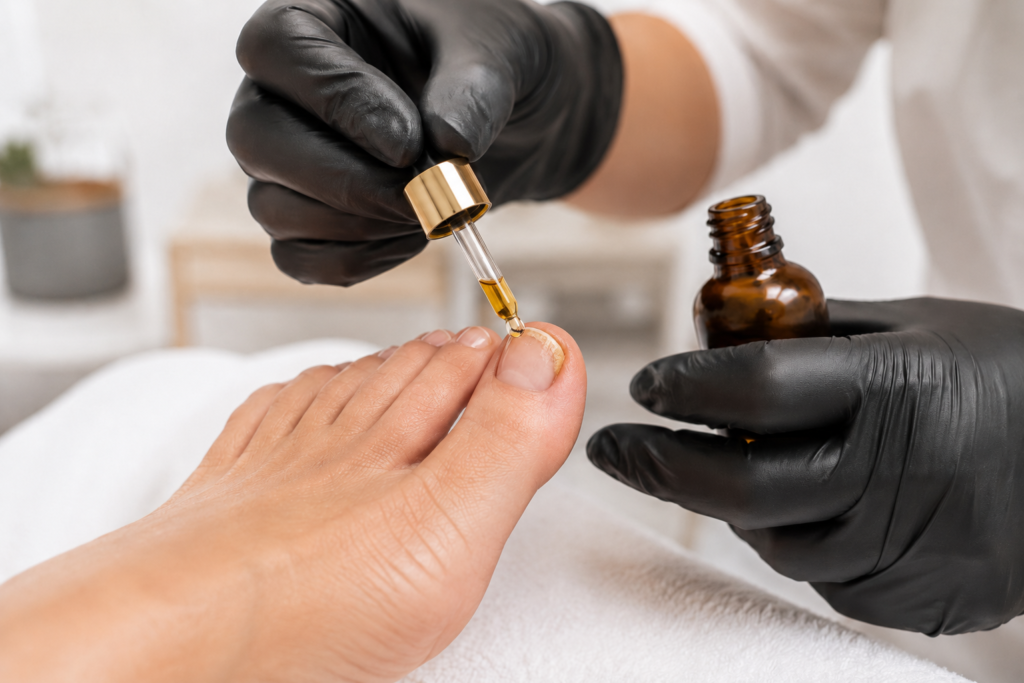
The conclusion: for toenail fungus specifically, topical delivery is more mechanistically defensible than oral supplementation. A product that delivers undecylenic acid and tea tree oil in a penetration-enhancing carrier directly to the nail is working with the biology of the infection. An oral product at supplement doses is not.
Tea Tree Oil — The Second Most Important Antifungal Ingredient
Tea tree oil is the most studied natural antifungal compound for onychomycosis specifically. A 2002 randomized controlled trial (PMID 11485891) directly compared 100% tea tree oil to clotrimazole (prescription antifungal) for toenail fungus and found comparable efficacy for nail appearance improvement and culture conversion — a significant finding.
Tea tree oil’s mechanism involves multiple terpene components — primarily terpinen-4-ol — which disrupt fungal cell membranes through a different pathway than undecylenic acid. The combination of both ingredients targets fungal cell membranes via two distinct mechanisms, which is a pharmacologically sound rationale for co-formulation.
What I check on the label: Is tea tree oil listed as a significant component, or as a trace addition at the end of the ingredient list?
Other Antifungal Compounds in Supplement Formulas
-
- Clove bud oil: Contains eugenol — consistent in vitro antifungal activity against dermatophytes. Limited direct clinical evidence for onychomycosis specifically.
-
- Lemongrass oil: Contains citral — antifungal activity in laboratory models. Similar evidence profile to clove bud oil.
-
- Menthol: Penetration-enhancing properties — can increase skin and nail permeability to other active ingredients. Functionally useful even if its direct antifungal activity is modest.
-
- Carrier oils (jojoba, chia, flaxseed): Improve spreadability and contact time of the formula on nail tissue. No meaningful direct antifungal activity but serve an important delivery function.
What I Look for on a Toenail Fungus Product Label
-
- 1. Delivery format first: Topical liquid, serum, oil, or brush-on formulation. An oral capsule for toenail fungus requires a very strong explanation of how the active ingredient reaches the nail bed at therapeutic concentration.
-
- 2. Undecylenic acid as primary active, with concentration disclosed: FDA-compliant OTC antifungal products list undecylenic acid as a percentage — typically 10–25% for topical preparations. Without this disclosure, the product cannot be evaluated against the regulatory standard.
-
- 3. Tea tree oil as secondary active: Present at a meaningful amount in the ingredient list — not buried at the end as a trace addition.
-
- 4. Penetration-enhancing carriers: Jojoba, menthol, lavender, sweet almond oil — ingredients that improve formula contact with nail tissue and enhance active ingredient delivery.
-
- 5. Clear formulation, no proprietary blend obscuring key concentrations: For a topical product, the concentration of the active ingredient matters for regulatory compliance and efficacy evaluation.
Realistic Expectations for Toenail Fungus Treatment
What is realistic with consistent topical use of well-formulated products:
-
- Reduction in fungal load in the nail fold and surface nail tissue
-
- Improved nail appearance over 3–6 months with consistent daily application
-
- Slowing of fungal spread to adjacent nails
-
- Reduction in mild to moderate infection severity
What requires medical treatment:
-
- Severe onychomycosis affecting most of the nail plate
-
- Infections that have spread to multiple nails or persisted for years with significant nail destruction
-
- Infections in immunocompromised individuals
Severe onychomycosis needs prescription treatment — oral terbinafine or itraconazole, or prescription-strength topical ciclopirox. Supplement-grade topical products with undecylenic acid are appropriate for mild to moderate infection management and prevention.
The Bottom Line
Undecylenic acid is the most credible active ingredient in the natural antifungal supplement space — not because of marketing, but because the FDA has specifically evaluated and recognized it as an effective OTC antifungal agent. The delivery format is what determines whether it can reach the infection. For onychomycosis, topical application in a penetration-enhancing formulation is the most pharmacologically defensible approach.
You can see how I apply this analysis in my Kerafen vs ProNail Complex comparison.
Frequently Asked Questions
Does undecylenic acid really work for toenail fungus?
Undecylenic acid has FDA recognition as a Category I safe and effective OTC antifungal — meaning the FDA has reviewed the evidence and concluded it demonstrates efficacy at appropriate concentrations. Laboratory studies consistently show activity against dermatophyte fungi responsible for most toenail infections. In a topical formulation at appropriate concentration with penetration-enhancing carriers, it is the most credible natural antifungal option without a prescription.
Is undecylenic acid FDA approved for toenail fungus?
Undecylenic acid is FDA-recognized as a Category I (safe and effective) OTC antifungal active ingredient under 21 CFR 333.210. This applies to topical OTC antifungal products — not oral supplements. The regulatory recognition covers topical applications; oral supplement use of undecylenic acid falls outside this regulatory endorsement.
Can I take undecylenic acid orally for toenail fungus?
Oral undecylenic acid at supplement doses reaches the nail bed through the bloodstream, but nail perfusion is limited — which is why even prescription oral antifungals require months to accumulate sufficient drug in nail tissue. Topical delivery directly to the nail is more mechanistically defensible for onychomycosis. If you use an oral product, set realistic expectations and consider using it alongside a topical application.
Can undecylenic acid be combined with tea tree oil?
Yes — this combination is pharmacologically rational. Both disrupt fungal cell membranes through different mechanisms, targeting the same biological structure via two distinct pathways. The 2002 RCT showed tea tree oil comparable to clotrimazole. The combination provides dual-mechanism antifungal activity and is found in several well-formulated topical products.
How long does it take to treat toenail fungus with natural products?
Toenails grow approximately 1.5mm per month — complete nail replacement takes 12–18 months. Clinical improvement in nail appearance is typically observed over 3–6 months of consistent topical treatment. Clinical studies on prescription topical antifungals — the most rigorous comparison point — typically run 48 weeks. Natural topical products should be evaluated on the same time scale. Weekly or monthly results are not a realistic assessment window for onychomycosis.
What is onychomycosis?
Onychomycosis is the clinical term for toenail or fingernail fungal infection — characterized by nail thickening, discoloration, brittleness, and separation from the nail bed. It affects approximately 10% of the general population and up to 30% of people over 60. Trichophyton rubrum is the most common causative organism.
Does undecylenic acid kill toenail fungus?
Undecylenic acid does not instantly kill existing fungal colonies on contact — it works by disrupting ergosterol biosynthesis in the fungal cell membrane, which is the fungus’s primary structural component. Without ergosterol, the cell becomes unstable and dies over time with consistent exposure. This is why daily application for months, not a single treatment, is what clinical evidence supports — the FDA’s Category I recognition (21 CFR 333.210) is based on sustained topical use, not a one-time kill claim.
References
| PMID | Reference |
| FDA 21 CFR | FDA 21 CFR 333.210 — OTC Antifungal Drug Products (undecylenic acid Category I) |
| 8195735 | Buck DS et al. (1994/2002). Comparison of two topical preparations for the treatment of onychomycosis — tea tree oil vs. clotrimazole. |
| 29959962 | Lipner SR & Scher RK (2019). Onychomycosis: Treatment and prevention of recurrence. J Am Acad Dermatol. |
Analysis by Cris Canto, MSc Chemistry | 25 years of experience in Research & Development and Marketing in multinational consumer goods and chemical industries | All analyses are independent and based on publicly available label data and verified reviews.